

What is the difference between a cleanroom and a gray room? Which solution should you choose based on your business?
These two spaces represent different levels of environmental control. They share a common goal: to control microbiological contamination. Quality and safety are at the heart of the approach, but what is the difference between a cleanroom and a gray room? Photoclean has the answer.
What is a cleanroom, and what level of contamination control does it provide?
Cleanrooms are sterile environments in which the concentration of particles and microorganisms is strictly limited. They are subject to the ISO 14644 standard (Class 5, 7, or 8, as applicable).
The purpose of a cleanroom is to prevent any contamination of the product or process. This is a regulatory requirement in the pharmaceutical, medical, and hospital sectors. The biotechnology and microelectronics sectors also rely on them.
A cleanroom is characterized by:
- absolute filtration (HEPA or ULPA filters);
- a very high air exchange rate (up to 60 times the volume per hour);
- controlled pressure, temperature, and humidity conditions.
While extremely effective at trapping particles that carry microorganisms, this solution comes with high installation and operating costs. As a result, this controlled-environment model
may prove to be overkill and economically burdensome for certain sectors, particularly the food industry, where maintaining positive pressure is virtually impossible due to the numerous and frequent openings in the rooms.

What is a clean room or controlled area?
The gray room, which has less stringent requirements, is designed to reduce contamination, without aiming for sterility. The approach is based more on risk analysis than on strict standards. Furthermore, it does not conform to any ISO classification.
The use of gray rooms in industry allows for effective control of microbiological and chemical risks. They are easier to implement, more energy-efficient, and more cost-effective than cleanrooms.
Many sectors use gray rooms, particularly the food industry. These facilities often serve as production, cooling, or packaging areas. In these rooms, installing a cleanroom is often unfeasible—both technically and economically—but contamination must still be controlled and managed.
The main advantage of the gray room for manufacturers lies in its ability to accommodate large volumes and its compatibility with existing facilities.
How do you design and furnish a gray room?
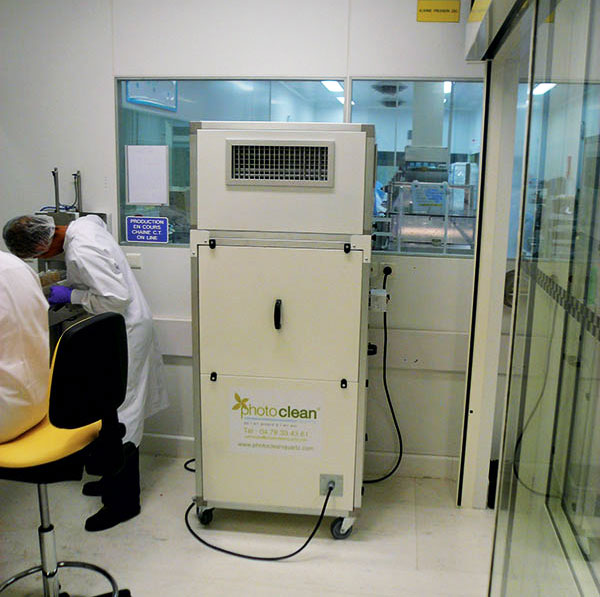
This type of installation requires the services of a specialized contractor. Photoclean has been working alongside manufacturers for many years. Our specialty? Air treatment using UV-C rays (photolysis).
<>We offer customized solutions to create your controlled industrial environment:
- site audit, including volume assessment and identification of contaminants;
- design of layout plans by our in-house engineering department;
- manufacturing of universal air treatment modules compatible with your air handling unit (AHU).
Thanks to UV technology, it’s now possible to treat an entire building while minimizing dead zones. This high-performance solution is far less restrictive than a traditional cleanroom, while still providing solid guarantees of quality and contamination control.
The choice between a cleanroom and a gray room depends on the industry, regulatory requirements, and the level of risk to be controlled. Contact Photoclean for expert advice.