

What is the air change rate for a cleanroom? Find out with Photoclean
Cleanrooms are often essential in the medical and pharmaceutical industries. By providing a perfectly controlled environment, these spaces meet high standards. For example, what is the air change rate for a cleanroom? PhotoClean, an expert in air treatment for sensitive sectors, has all the answers.
What is a cleanroom, and what is its purpose in industry?
The term “food industry cleanroom” refers to a space in which pressure, temperature, and humidity are strictly controlled. This helps prevent any risk of microorganisms or particles entering the space, ensuring the absolute safety of the products and the security of the processes. Air quality in cleanrooms is therefore a key factor.
A cleanroom can also be maintained at positive pressure—which protects it from the entry of particles—or at negative pressure—which prevents the escape of microorganisms present, for example, in a laboratory.
Cleanrooms are used in a wide range of industrial sectors, including pharmaceuticals, research, biology, nuclear energy, and the food industry. All must comply with the ISO 14644-1 standard, which applies to the space as well as to surfaces and equipment.


What are the air change rates for a cleanroom?
The air change rate in cleanrooms depends on the ISO class of the environment. Cleanrooms are classified on a scale from 1 to 9, with ISO 1 representing the highest level of cleanliness. Each class requires a decontamination time that is ten times faster than the class below it.
ISO cleanroom classifications depend on the number and type of particles allowed without compromising quality. For example, an ISO Class 1 cleanroom allows a maximum of ten particles with a size of 0.1 µm or less.
Naturally, these requirements entail a massive air exchange rate, which increases with the ISO classification. An ISO 8 room requires the air to be exchanged at least ten times per hour, while an ISO 5 room requires an exchange rate of up to 60 times per hour!
Finally, cleanroom design involves heating, humidification, and air filtration, which entails significant costs for professionals in the relevant industries.
How can you ventilate a facility in the food industry?
While the medical industry cannot do without cleanrooms, other sectors can manage without them. Air treatment in the food industry focuses primarily on microbiological contamination and pays little attention to airborne particles. This reduces the size of the necessary facilities, as well as the amount of energy required.
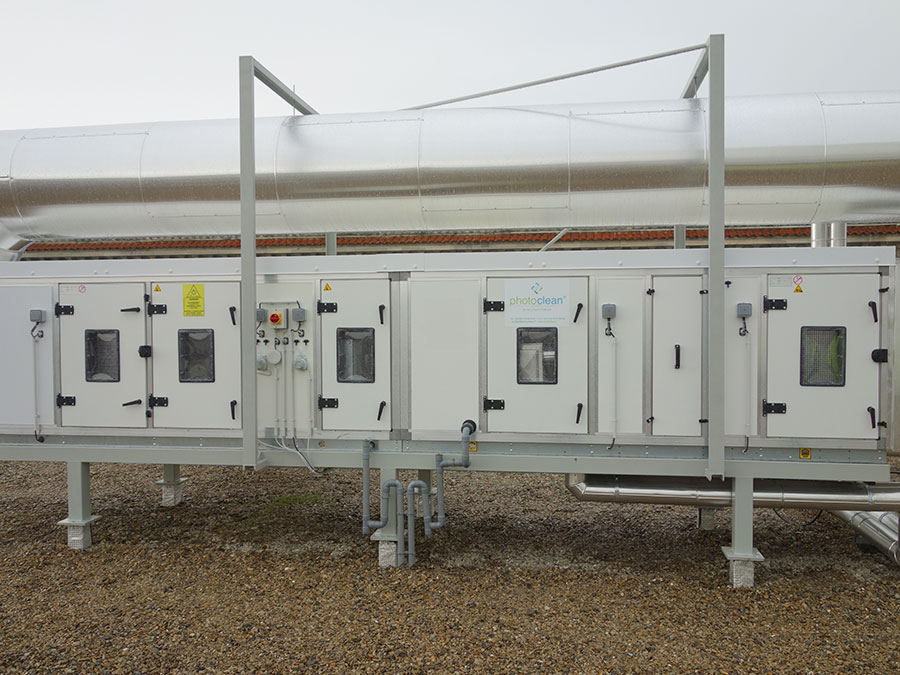
Good air quality in the food industry requires adequate air exchange and parameters tailored to the specific activity. Photoclean treatment solutions harness the biocidal properties of UV-C to ensure healthy air. Our modules offer three key advantages: space savings, optimal quality, and reduced energy consumption.
Here are two examples:
- In a milk powder production plant, the size of the air-handling units is reduced by a factor of 3 and the installation cost by a factor of 2.5. Energy consumption is cut in half.
- In an industrial bakery, there is no need to treat particles. This is because the raw material—namely, flour—naturally produces them. It is therefore better to target microbes directly—particularly yeast and mold—which tend to proliferate due to temperature, humidity, and ambient moisture levels.