
Air Purification or UV Purification? An Overview of the Different Techniques
Air purification, filtration, HEPA or activated carbon filters… There are so many techniques designed to improve indoor air quality that it quickly becomes difficult to know where to start…
Are you looking for an effective solution for your business premises? Photoclean, a specialist in air decontamination, offers you an overview of the various solutions available to you. What are their advantages and disadvantages? And most importantly, how can you determine which method is best suited to your situation? Follow our guide…
What is an air purifier?
An air purifier is a device that must be plugged into an electrical outlet to operate. It is usually equipped with a fan and a system designed to capture or destroy various microbiological or chemical contaminants suspended in the air.
This generic term actually encompasses all technologies designed to combat indoor air pollution: mechanical filtration, plasma, electrostatic filtration, ozone, ionization, UV-C radiation, and more…
However, while they generally share the same goal, each of these techniques is quite different and has its own unique characteristics. To ensure you make the right choice, you need to assess your constraints (budget, energy consumption, space, site layout, nature of the premises and the business, etc.) in order to select the most suitable solution.
The Main Water Treatment Techniques, Their Advantages and Disadvantages
Mechanical air filtration is the most widely used technique today. The filter acts as a “sieve” and traps particles larger than the diameter of its mesh. HEPA filters (also known as absolute filters) are the most effective, as they block 99.95% of the finest particles. They thus capture the majority of pollutants attached to inert airborne particles.
However, this efficiency comes at a cost, since this type of filtration places significant pressure on the air, resulting in large machines and high energy bills. In fact, for decontamination to be effective, the air in the room must be replaced 20 to 30 times per hour. Add to this the fact that contaminants are not destroyed but stored inside the filters, and there is a potential risk of increased contamination inside the units themselves in the event of humidity if the filters are not changed regularly…
Activated carbon filters, on the other hand, are known for their adsorbent properties: they trap large molecules. However, once again, contaminants are not destroyed but merely stored. Their effectiveness against microorganisms is virtually nil, and they do not function well in high-humidity conditions.
The disinfection by misting involves spraying a “mist” composed of various oxidizing agents (CH₂O, H₂O₂, O₃, etc.) to eliminate any contaminants present. This method is effective when used occasionally after a period when the premises are unoccupied (such as on the weekend), but it requires that the premises be empty due to the high chemical concentration of the mist. Furthermore, as soon as the premises are occupied again, contamination resumes.
These various methods, known as “traditional,” each have their advantages but also clear weaknesses, starting with high costs and effectiveness that may be limited depending on the occupancy of the premises, the nature of the facilities, and the nature of the contaminants present.
UV Air Decontamination: The Ideal Solution?
While there is no “miracle” solution per se, UV decontamination has the immense advantage of directly eliminating microbiological and chemical contaminants present in the ambient air rather than storing them.
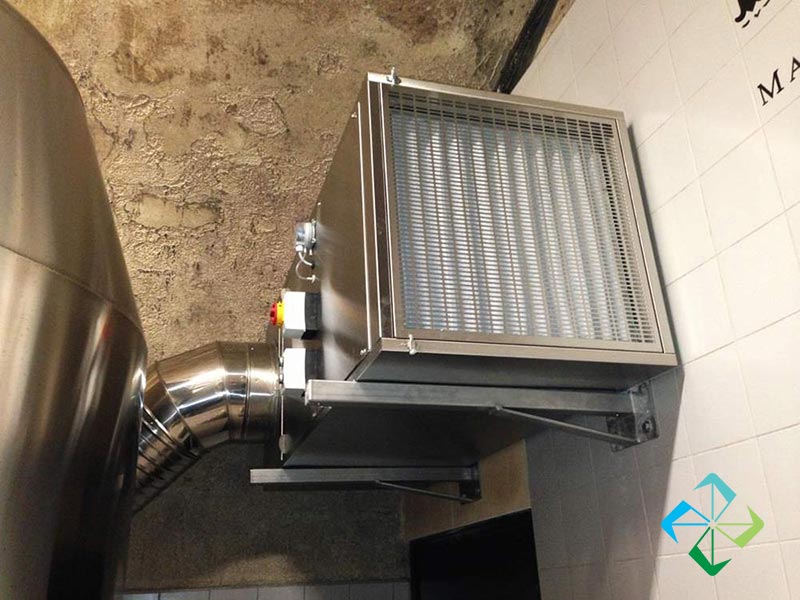
Once used primarily for water disinfection, UV technology can now—thanks to the Photoclean solution—continuously purify large volumes of air in offices, hospitals, and production facilities.
In fact, to address the issue of wavelength (UV-C rays have a short wavelength), we have incorporated a proprietary medium into our UV modules. The combined effect of these two products triggers photolysis, a natural reaction that eliminates contaminants without leaving harmful residues in the air.
Because they target contaminants directly rather than inert particles (which are far more numerous), our devices consume significantly less energy and are also more compact, while remaining just as effective. With their continuous operation, they ensure reliable and consistent decontamination and do not require you to interrupt your operations. Ultimately, you realize real savings across the board.
Would you like more information about our custom products and services? Contact us!